
How California Assembly Bill 660 Tackles Food Waste
How California Assembly Bill 660 Tackles Food Waste
AB 660 will change the way California labels food items, eliminating confusion and reducing food waste
As California prepares to implement Assembly Bill 660 (AB 660) in July 2026, a critical opportunity is emerging to address two deeply connected challenges: food waste and food insecurity. For the Los Angeles Regional Food Bank, this new law represents meaningful progress toward a more efficient, equitable, and sustainable food system, one where perfectly nutritious food ends up on dining tables, and not landfills.
What Is AB 660?
Starting on July 1, 2026, AB 660 will standardize food date labeling across California to eliminate confusion that often leads to unnecessary food waste. Instead of a wide range of unclear phrases currently used, like “sell by,” “expires on,” or “freshest before,” food packaging will use just two simple terms:
“BEST if Used by” – indicating peak quality
“USE by” – indicating food safety
The law also prohibits the use of “sell by” labels for consumers, which have historically caused shoppers to throw away food that is still perfectly safe to eat.
The Impact of AB 660 on Food Waste
Food waste is one of the most overlooked drivers of hunger. According to the Los Angeles County Sanitation Districts, about 4,000 to 8,000 tons of food waste is generated daily in our County, with roughly 1.7 to 1.9 million tons sent to landfills annually. A significant portion of that waste is due to confusion about food date labels.
When food is thrown away unnecessarily:
- Families lose money on groceries
- Perfectly edible, nutritious food is removed from the supply chain
- Landfills fill up faster, producing harmful greenhouse gases like methane
At the same time, 1 in 4 people in Los Angeles County experiences food insecurity—a stark reminder that food waste and hunger are two sides of the same issue.
The Food Bank’s Role In Reducing Food Waste
Over 50 years ago, the Food Bank’s founder, Tony Collier, was trying to rescue perfectly good food from going to waste. The Food Bank continues his work of accepting food and product donations from growers, supermarkets, and distributors and providing them to those in need throughout LA County.
At its City of Industry Distribution Center, the S. Mark Taper Foundation Food Rescue Center is where volunteers sort, glean, and pack rescued food for our neighbors in need.
Additionally, the Food Bank works with hundreds of grocery stores, restaurants, and bakeries around LA County to prevent food waste through the Extra Helpings Program. For over 20 years, the Program has rescued millions of pounds of food that would otherwise go to waste and distributed it to neighbors experiencing nutrition insecurity.
In 2024, the Program connected 215 partner agencies to donated food from 558 local donors. Agencies rescued 29.4 million pounds of food for distribution to neighbors experiencing nutrition insecurity, the equivalent of 24.5 million meals.
As the Food Bank continues its work to fight food and nutrition insecurity, consider joining the fight against hunger. Consider donating, volunteering, or sharing our stories with your loved ones throughout social media.
More Stories from the LA Regional Food Bank
Supporting Students Beyond the Classroom: The Backpack Program at Nevin Elementary
At Nevin Elementary School, supporting students goes beyond the classroom. By taking care of the whole child, students are better able to learn, grow, and thrive.
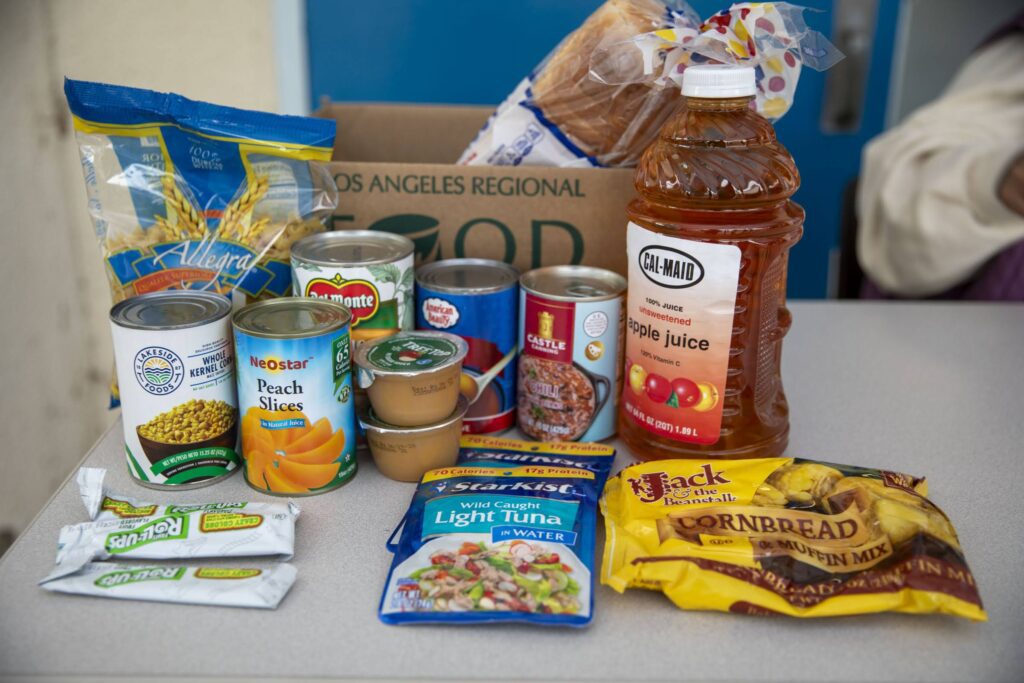
How to Find Free Food Resources in LA County
Whether you are seeking free food assistance for the first time or have needed support before, help is available.
Domitila Wants to See Her Grandson Thrive. The Food Bank is Here to Help.
Families like Laura’s depend on programs like the Food Bank’s Backpack Program to help feed their families when school is not in session.
New Tax Rules, New Ways to Give to the Food Bank
Recent changes to federal tax law may affect how you support the LA Regional Food Bank and other nonprofits.